I awoke Saturday morning in time to see a beautiful sunrise. The temperatures were still warm and the sky was mostly clear. I was optimistic but knew that bad weather was due to arrive from the west sometime in the afternoon. Maybe I could get out, perhaps to Johnstown, wait for the weather to pass and resume my trip. Johnstown was flagged Red = Limited IFR. The NEXRAD composite behind the cold front was just ugly. A southern route wasn't much better. No Go again on Saturday.
Sunday brought low ceilings gray sky, much colder temperatures and limited visibility. The maps had local airports flagged mostly Blue = Marginal VFR. However west, out near Pittsburgh it was improving and the little airport symbols were Green. I packed my overnight bag, poured some coffee in a Chinet cup and headed out to the airport. Go - IF the local weather stayed VFR.
I put the oil cooler baffles on anticipating the colder temperature and was glad to have them. Heat started to come into the plane as the oil warmed up. All ground operations were normal. The 696 showed nothing awful along my route of flight. The engine purred. I pushed the trip reset button on the timer and advanced the throttle. We were off.
Well, at least up to 2500'. Enough to clear the nearby mountains but not where I had intended to cruise. I dialed up Allentown for Flight Following and wen I stated my altitude he asked if I intended to climb. "As soon as the weather would let me." I diverted around some showers over Reading which showed as yellow blotches on my 696. We were able to climb up another 1000' just before the next ridge line and stayed there until descending for the fuel stop south of Pittsburgh.
A quick turn and off again heading west. By now the ceilings were a bit higher so we leveled off at 4500'. All systems were normal so I settled in for a nice cruise. The skies were still gray and after awhile we started the scratch the bottoms so I told ATC we would drop down 1000'. That worked well for most of Ohio, until it started SNOWING! Truly beautiful but not good for VFR flying. Visibility was deteriorating rapidly and I advised ATC that I would go down another 1000'. He cautioned me that we might lose radar contact. I weighed the options and decided that Sally was a VFR kind of girl, we went lower. Approaching Wright-Patt most of the snow showers were behind us and we climbed back up to 4500'. Smooth sailing into our first overnight stop at KMTO.
*A beater of a crew car (and thankful to have it), Hampton Inn honored a Military Discount. It was a good stop.
Frost. Monday morning and Sally is encased in a block of frost. Fortunately there were clear blue skies overhead and the temperatures were rising quickly. Time enough for some more great FBO coffee and hangar talk with the guy sitting behind the desk. I waited about an hour before my soft squeegee could remove all of the frost from the airplane.
We had an easy climb up to 6500' and settled in for the next leg. Smooth air over very flat country. Crossed the Mississippi near St Louis and had a nice conversation with the controller about LSA flying.It was starting to get warm, OAT read 10C and rising. Two hours out and the next rest stop came into view.
Another quick turn and another uneventful climb to 6500'. Still flat country, but getting warmer all the time. I took my lightweight sweater off and closed the heater vent. We were heading back into Summertime. The oil temperature showed that as well as we were now running on the high side of the green arc. Not a full fledged worry but something to keep my eye on. I pulled out my tablet and opened PILOT to look at fuel prices. Eureka, Kansas had some MOGAS so I asked ATC to change my destination and we headed there. Winds were picking up and airports in the area were posting gusts in the twenties, 13K had the winds pretty much straight down the runway which gave me another reason to divert.
The MOGAS was only 87 octane, not good for Sally. We went with Avgas instead. There was a drop of oil on her nose wheel pant. Argh. All of the work Harry had done came into my mind. Did something come loose? Cowling came off and everything was dry, except the oil reservoir overflow. The oil had to expand due to the heat (baffles still on). It was below the flat on the oil stick so I added a little and removed the baffles in the blowing (but warm) wind. Triple checked everything and off again.
Climbed back up to 6500" and everything was solid. Oil Temperature and Pressure were solid and steady, and blew a sigh of relief. After awhile my next overnight came into view. KWWR was great! A Cadillac crew car, good prices and wonderful hospitality. (Hampton Inn was unable to honor the military discount this time.)
The landscape changed again in Oklahoma with the ground becoming more scarred with gullies and washes. The ground was rising up to meet me. Lots of cattle pens and brown open spaces. Two fuel stops later I was wearing a T-shirt and the air vents were wide open. This time I climbed to 8500' and battled head winds approaching the mountains. Soon I learned something. Sally was trying to maintain altitude and was struggling with it. I advanced the throttle to full, slowed to Vy and still descended at 200 FPM. Crossing the next plateau we climbed at over 1000 FPM and I had the throttle near idle. It didn't take too many cycles to learn that altitude hold wasn't going to work out here in these windy conditions. So I pushed the buttons to give me GPS track mode and hand flew the altitude. Around Los Vegas, New Mexico I decided that getting beat up by the turbulence wasn't fun anymore and took her up to 10,500', which meant higher head winds but somewhat smoother air.
KGNT: last fuel stop. I wove down through the mesa and valleys looking for this tiny airport. I wasn't sure if it would be near a town or on top of one of the Mesa flats. Neither, it out of town near I40. Self serve, full tanks and taxied out. Altimeter read 6500' on the ground! I clicked the CTAF frequency and mentioned that and the FBO came back with the Density Altitude of 8,300'. Visions of that now infamous YouTube video came to mind. I let her accelerate a long time before easing back on the stick. Slowly, slowly she climbed. I turned back to climb up over the airport before turning on course over the mountains to the southwest.
I was thirsty and had already downed my two water bottles. Should I dare to open a can of Coke Zero at 10,000 ft? I thought better of it and munched on some nuts instead.
I also learned that a magenta GPS track may go straight over a peak that is higher than current altitude. Heading mode to divert around the big ones, then Direct/Enter/Enter when clear. Many times I was pitch up, full power and could barely maintain altitude. Mountain flying is just a bit different. My six hour day turned into a long 8 hours as I passed the last range into Phoenix airspace.
By now the Sun was low on the horizon, the glare was painful and the haze was unbelievable. I told the tower I was three miles from the field and still couldn't make out the airport. A vector to downwind helped and soon the long runway was in front of me. Smooth landing, off at Alpha 10 and a kind ground control gave me some help to get over to Landmark Aviation.
I shut her down and checked the trip time at 22:26.
Tuesday, October 16, 2012


Thursday, October 11, 2012
Maintenance Check Flight
Cell phone technology is truly amazing, but it doesn't always work. Thursday I got my coffee and went into the office to check email and found I had missed a call from Harry. I called him immediately. Sally was back together but needed some tuning. Twenty minutes later I was sitting in the airplane ready to start.
It was a rough start. So he adjusted, I cooperated and together we worked through the morning to get her running smoothly again. But the weather was lousy with low ceilings and poor visibility. So I waited. By mid afternoon it had improved enough to take a lap around the field and all indications were good, except...High idle. Sally likes to land with no power and even a little throttle cause her to float. I think I must have bent the throttle arm trying to pull the power off, but a good slip and a little patience got us down at Butter Valley safely. Harry said that would be an easy adjustment. Now I wanted to do some more testing.
Friday was perfect. If she had been ready I would have started the trip, but I still had some questions. Preflight complete (looking very carefully at every hose, wire and engine component) I pulled her out of the hangar, climbed in and turned the key. Smooth. Next we taxied over to the little asphalt pad for an extensive run up. Nice. Next I sat on the runway and added full power while holding the breaks, which seemed like eternity but was really only thirty seconds. Power was good everything else normal. Once released she rolled down the runway and was ready to fly before the dip and hill, sooner than normal. So far so good.
Speed check. 6500' and 5450 RPM yielded 115 kts. Not as good as new but consistent with previous tests. I was satisfied that she passed that test. Altitude check. Up to 8500' at cruise climb speed (~75 kts), no problems noted. I was convinced she could go higher if I wanted to, but this was good. I was satisfied that she passed that test. Next I descended down and joined the pattern at N47. Idle still high I extended a bit and made a 'floater' but safe landing, then taxied over to pumps to top them off. I can count on one hand the number of times I've actually flown with a full fuel load.
Endurance check. I picked 4N1 as a way point which is just under an hour's flight north. I wanted to do a normal cruise, check all systems to be sure I didn't have any unexpected problems (like a malfunctioning autopilot) and to make sure that running the engine under normal flight conditions didn't uncover any new issues. It was a pretty day, smooth air and the engine just hummed. I was satisfied that she passed that test.
So the only thing left to adjust was the idle. I put her back in the barn, pulled the cowling and checked everything. Clean and dry. I called Harry but he said he would be unavailable until Monday. Rats. I went home for lunch. Did I mention how great cell phone technology is? Harry called and said if I flew up to Slatington (69N ~ 20 minutes north) he would adjust the idle for me. Gee, that would mean I would have to fly twice in one day. Done deal.
It was a bit more than just a 'simple adjustment' but after a few trips around the pattern the idle was perfect. Harry suggested I get up to 4500' on the trip home to insure that the auto adjusting carbs still worked properly. I did, and they did. I was satisfied that she passed that test.
We were ready to go. Now if only the weather would cooperate. It didn't.
Saturday, September 22, 2012
Grounded
I woke Friday morning in a fog. No, not a hangover, a dense fog surrounding the neighborhood. I doubt I could see beyond ten yards. The thickest I have seen in a long time.
It had cleared by midday and I ventured out to see how Sally was doing. She is in for a 200 hour checkup (Hobbs is at 195 hours). When I stopped by Harry had the covers off and was checking compressions. #1 was a little low but well within limits. He found a frayed cable to the right side carburetor. There was a drop of water in the left carburetor bowl, and he showed me how he had added a safety wire to hold the latching arm in place. And then he showed me something else. The #1 cylinder top left bolt would not hold its torque. It would 'back off' just a bit after reaching the 200 ft-lbs on the wrench. We also saw some residue on the upper cowling and on the wiring under the head. It wasn't necessarily wrong, but it wasn't right.
He called me later in the afternoon to come by and check it out. The valves and rings and other internal parts all look good. There is some grime on the top and bottom of the casing and head. Next step is a thorough cleaning. Hopefully new parts won't be required.
You do inspections for a reason. I'm planning a long cross country and it is oh so much more important to find any problems now than during the trip.
Trip Notes:
 Nexus7:
I finally broke down and entered the tablet age. An Ipad just seemed too large for the cockpit, even though it seems that Foreflight is a mandatory app these days. I went with the Google solution and am trying Garmin Pilot as a navigator. I want the ability to plan at home, and disconnecting the 696 really isn't feasible. This tablet solution allows me to do the planning, then add the way points into the 696 as needed. User reports will be forthcoming.
Some videos I like:
Some discussions I've been following:
It had cleared by midday and I ventured out to see how Sally was doing. She is in for a 200 hour checkup (Hobbs is at 195 hours). When I stopped by Harry had the covers off and was checking compressions. #1 was a little low but well within limits. He found a frayed cable to the right side carburetor. There was a drop of water in the left carburetor bowl, and he showed me how he had added a safety wire to hold the latching arm in place. And then he showed me something else. The #1 cylinder top left bolt would not hold its torque. It would 'back off' just a bit after reaching the 200 ft-lbs on the wrench. We also saw some residue on the upper cowling and on the wiring under the head. It wasn't necessarily wrong, but it wasn't right.
He called me later in the afternoon to come by and check it out. The valves and rings and other internal parts all look good. There is some grime on the top and bottom of the casing and head. Next step is a thorough cleaning. Hopefully new parts won't be required.
You do inspections for a reason. I'm planning a long cross country and it is oh so much more important to find any problems now than during the trip.
Trip Notes:
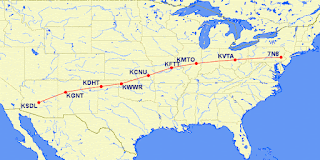
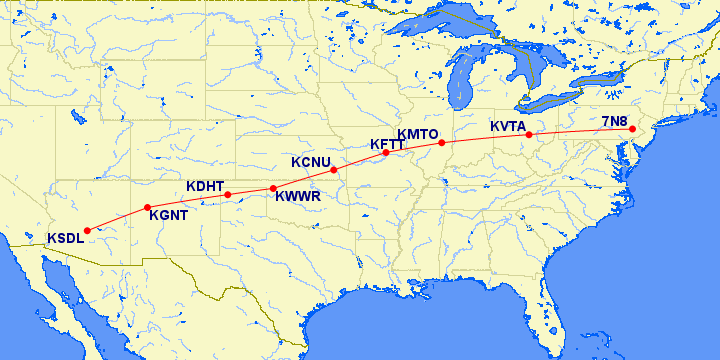
7N8 - KVTA - KMTO - KFTT - KCNU - KWWR - KDHT - KGNT - KSDL
I finally broke down and entered the tablet age. An Ipad just seemed too large for the cockpit, even though it seems that Foreflight is a mandatory app these days. I went with the Google solution and am trying Garmin Pilot as a navigator. I want the ability to plan at home, and disconnecting the 696 really isn't feasible. This tablet solution allows me to do the planning, then add the way points into the 696 as needed. User reports will be forthcoming.
Some videos I like:
Some discussions I've been following:
Friday, September 14, 2012
Near and Brief
The sun is setting sooner and work is lasting longer. I got out to the airport around 6:00pm. My mission was to do a TAS check. Sally just passed 190 hours on the Hobbs and is going down for maintenance next week so I wanted to do a speed test to use as a baseline.
As we departed Butter Valley I saw a hot air balloon to the south and decided to climb up to see it. The air was calm with a slight breeze from the south and a thick haze layer at about 4000'. I circled the balloon as I climbed, far enough away not to be intimidating, but close enough to enjoy a great view of this colorful aircraft. I got a spectacular view as I maneuvered between the balloon and the sun from a slightly elevated position. What a joy to be sharing the same air space.
The test didn't give me the results I had hoped for. 6500', 5450RPM (6.2 gals/hr) yielded 115 Kts TAS. I had expected 120 kts. Many factors are involved and one might be using 93 octane gas with ethanol instead of 100ll Avgas in my tanks. Another may be its time for Sally to get a good tune up.
* My Aeronautics professor would be very disappointed. The engine developed 5450 RPM regardless of fuel or other factors. It did its job. This reduces to a thrust vs drag problem. A different propeller would change the equation and reducing the drag would help. Maybe Sally needs a bath.
Only a short flight, the sun was setting and I don't trust the lighting at 7N8. Normal pattern and landing and put her to bed in the barn. As I was driving away I could see the balloon was also landing, but over on the other side of town.
"Adventure, after all, doesn't have to be distant or prolonged in order to be worthwhile." - Lane Wallace. Please read her full article here.
Sunday, September 9, 2012
17N
 |
| Philadelphia |
Today I thought of that as I did my magneto check. Left was fine, right dropped a bunch and was rough running. A few common solutions came to mind but at the end of it the right mag just wasn't cutting it. I taxied back, shut her down and pondered. Got out and decided to pull the upper cowling off only to find a loose plug wire. Yes, I had done a preflight and I always 'push' on the plug wires as a routine check. Son of a gun. No explanation.
Started right up (no choke) taxied back out and this time the run up was fine. I took off with the intent of staying close 'just in case' but all indications were good. Sally and I did a small round robin underneath the shelve of the Philadelphia Class B airspace with a stop at Cross Keys. Along the way we flew over KLOM, 19N, 7N7 and KPTW.
The procedures work if we take the time to use them.
Tuesday, September 4, 2012
Canopy Latch Handle
About a year ago I was practicing landings over at Quakertown. Satisfied with the progress I had made that day it was time to depart. Shortly after take off the canopy began to rise a little bit. I considered a landing attempt but it was already too late for that so instead I was forced to go around. Fly the airplane, Fly the airplane, Fly the airplane.
Climb to the downwind was normal. Level off was fine, although I did notice the wind noise. I stayed below 75 knots the whole time and was beginning to think it was a 'non-event' until I turned on base. As the nose pitched down, the canopy went up. More wind noise and something behind my seat was trying to escape. It turned out to be my sun cover and a chart or two.
I had no controlability issues. I was distracted and really had to concentrate on the basics. I made a normal, full flap landing and safely taxied off the active runway. I diligently went through the take off check list again, triple checked that the canopy was down and latched and flew home. Now I always check the handle position, push up on the center of the canopy and visually check both sides to insure each latch is engaged.
This is a good description and video of a canopy open in flight.
I figured that was all there was to it until I started reading some posts on the yahoo group board. We had all been waiting for the reults from an investigation on a PiperSport that had crashed in Florida last year.
..and there was this from a friend flying in Hawaii, who bought his plane the same week I bought Sally.The NTSB has just posted the Factual Report on the May 6, 2011 fatal accident of a Piper Sport in Florida. The unusual aspect of the accident is that the pilot's body was found 1800 feet from the aircraft wreckage. Based mostly on the location of abrasion marks on the pilot and the location of baggage items extending from the flight track to the crash site, the report suggests that the pilot's seat belt was unbuckled, maybe while reaching for something in the back, and the canopy opened in flight with a suggestion that either a loose shoulder harness or a headset cord wrapped around the canopy release and opened it. (Full report)
Looking aft

To add a little to the discussion on this topic: A fellow pilot flying my Piper Sport did experiance the canopy opening at about 100 knots. The result was a violent pitch down, the canopy going almost vertical and the negative G ejection of everything lose in the baggage compartment (manuals, camera, sun cover, chocks, etc.) He got pitch under control, slowed to 65 kts and landed with no damage. Lessons: (1)NEVER unbuckle the seat belts in the air. (2) The canopy opened because only one of the catchs engaged and the "push up on the canopy" preflight check will not catch this condition. Best to do a visual; check of both sides also.As a group the PiperSport/Sport Cruiser owners started thinking of additional safeguards. Today I experimented with a bungee approach. I don't particularly like purple, but this might be effective. I like it because it is simple, it keeps the belts and cords from getting underneath the handle and its easy to install. We're still looking for good ideas, please don't hesitate to offer them.
Looking down
Joe Kiefer

Saturday, September 1, 2012
Saturday Morning Fly-about
 |
| Cleaned up |
 |
| Preflight completed |
 |
| Ready to climb in. |
Sally looked pretty good with the bugs cleaned off her canopy, leading edges and wheel pants. But she needs more than a quick cleaning, some dirt still shows on her fuselage and empennage. The belly could use a wash as well...but not today.
We took off to the north heading west of the ABE airspace toward the mountains that define the northwestern edge of the Lehigh Valley. No rain, but haze and low ceilings made it a poor day to take pictures. The CTAF is also used by University Park and I heard a few planes checking in for the opening game at PSU. I turned left and headed down the ridge toward Reading while following the Lehigh River. Lots of little hilly knobs protruded from the dark green Pennsylvania farmland. I made another left turn and overflew Kutztown. The Runway Diner was very busy this morning, even though there isn't a runway anymore.
I headed over to N10 to see if anyone was home but the CTAF frequency was quiet. I punched 7N8 nto the GPS, turned on the autopilot for the first time this flight and let Sally take us home.
Butter Valley was quiet and my first landing was just "OK". I back taxied and prepared for another turn in the landing pattern. The next one was nice, however I'm not as consistent as I would like to be. hmmm, maybe I need more practice.
Subscribe to:
Posts (Atom)