Sunday, February 28, 2016

Fluctuating Oil Pressure

Original Plan to KFFC

We had a very busy Friday night so missed our start time on Saturday. We were in the plane heading for the run-up by 10:30. It was a beautiful day, clear skies and light winds. We took off on Rwy36 and departed to the north, picked up Flight Following through the busy Tampa airspace and climbed to 4500ft. I completed the climb/cruise checklist and settled in for the 2+ hour flight to our fuel stop at KMGR. Tampa cancelled Flight Following just north of the Class B. We were just above the haze layer and found headwinds at about 25-30kts but smooth air. After about 45 minutes I saw the flicker. Oil pressure dropped into the yellow but immediately recovered to nominal in the green. I thought about all of the work that had just been completed. For the next five minutes it fluctuated about 10psi but stayed green. I relaxed a bit, but made my contingency plan. Where are the airports along this route? Then another dip into the yellow. Any vibration? Any other indications? Any changes in engine temperatures? Any visible oil film? All answers were "no".

Then she dropped into the red. "We are aborting the flight", I told Kathy. I immediately clicked off the autopilot and turned right. Crystal River was slightly south and doable. Oil Pressure went back to green. Went through my checks again. Was there ANY other indication? No. "I think we'll go home". With the tail winds it should be about 30 minutes. Back in the red, reading 0, then 2 psi, for just a second then green. Still no other indications. Then back in the red for 5 seconds.

The closest airport with the longest runway was Brooksville (KBKV). Kathy asked if she could help, she could see I was busy. I told her my intentions to land at Brooksville about 15 miles ahead of us. I love my 696. I dialed up tower and told them I had fluctuating oil pressure, and gave my position. The Tower guys were GREAT!. He asked me to call a 3 mile base for Rwy9 and he worked on clearing traffic out of my way. A C130 was in the pattern doing parachute drops, and a few other planes were vectored out of our way. I came in high (intentionally) and started to slip her in once on final. Nice to have a 7000ft runway. We turned off at the first taxiway and made our way over to the FBO.

GA Knights.
It's a Saturday morning and you need a professional mechanic. Say you're at home and need a plumber or an electrician or whatever. You know it is not going to be a good experience. But this is General Aviation. We walked into the FBO and were treated like friends. No mechanic on duty but there is a group of guys working on their airplane in one of the hangars. He is an A&P and may be able to help. Within 10 minutes Nathan, Chris and James come driving up in a golf cart. James is A/P I/A but hasn't any experience with ROTAX Engines. But he CAN trouble shoot some common problems.  After some time to scrutinize the systems he takes a look at the oil pressure sending unit. One of the pins in the connector is loose. Maybe the smoking gun? He puts it all back together and we do a run up. All good. He cautions that there might be something more serious but without doing more in depth analysis he couldn't be sure. I thanked him for the help and asked what I owed. "Nothing, just glad to help."

I also called Patrick at US SPORT for his advice. He was out flying, but when he returned immediately called back and left a message. From the description I provided he suspected the sensor.

I put the cowling back on and told Kathy to wait in the FBO while I went for a test run. The test flight was all good. I picked Kathy up at the FBO and flew the 10 minutes back to Tampa Executive. I'll take her back down to Sebring for a "more in depth analysis".

We all gripe about the costs of flying, the over regulation, and all of the annoyances we face each time we go out to fly. We don't talk enough about the wonderful community that we have. Complete strangers treating us like family. What a privilege it is to be a part of GA.

Friday, February 26, 2016

at Lockwood

Another Logbook entry
Its been 5 years. We flew Sally home to Butter Valley from Florida in December 2010 and really started flying operations in the winter months beginning 2011. The Rotax Line Maintenance manual says that every 5 years a full rubber replacement must be done on the 912ULS engine. I called Lockwood Aviation Repair to get an estimate (about $3K) and made the appointment to get it done. As I checked my logs it also made sense to get a Condition Inspection done. Since I was already getting some work done, Joe gave me a price break ($0.5K).

During those first few cold months of ownership in 2011 I made a mistake. At that time my preflight did NOT include removing the upper cowling, instead just opening the oil access door and peeking inside. It has since changed, but at the time I thought it was sufficient. (Especially on a really cold February morning.) Runup and all ground ops were normal. But during the take off roll I got a CHT High warning. Too late to abort I made one lap and landed. The old coolant bottle had a design defect that allowed the tube to come loose from the cap. Mine had done that, robbing the needed coolant from the engine. Overheat.

So when I mentioned to Joe that I had a minor oil leak, Joe thought it was probably loose head fasteners needing to be re-torqued. She had also, just recently started to have a coolant leak. Then I got "the" phone call. That hot flight 5 years ago had damaged the heads. The heat had taken the temper out of the aluminum. 3 of the 4 heads would have to be replaced, and the 4th was right on the edge of the hardness test. Expletives, etc.

So Sally got 4 of the new and improved style heads installed. ($6K). Except for a few minor problems (left break pads, ELT batteries) had a good Condition Inspection. Joe said she should be ready on Monday. Then I got "the" phone call. Joe wanted to know if I had any start problems. Until recently she started after a few blades. Well, not anymore. Test showed that the ignition modules were in the process of failing. Expletives, etc.

So Sally got the new and improved style soft start ignition modules. ($2K).

Yes, she DOES run better, has more power, runs smoother, starts easier. I'm relieved to have her back and so grateful we didn't have a problem while flying. I'm also VERY glad to have found our new A&P.

I think she needs a good test flight.

Monday, January 25, 2016

Sebring - 2016

2016 US Sport Aviation Expo
The shuttle van took a few minutes to transport me from the transient ramp to the entrance of the show. I sat in the front seat and talked about Florida living with the driver. He had come down to enjoy to the longer tennis season. We all have our reasons.

It was a $20 entrance fee for the day, discounted if you are an AOPA or EAA member. The Welcome Booth sits just inside that gate and the volunteers were smiling and happy to give out brochures. The sun was shining and the temperatures were in the mid 60s, just perfect for an airshow.

I walked past the yellow re-imagined C150 and the SeaRey, noticed the mockup for the M.V.P. amphib on the other side of the ramp and made my way down to US Sport Aircraft. Patrick had 2 airplanes on display and one in the demonstration area. Sally has some beautiful sisters. The tail feathers are a little different, the nose strut has been improved, but the real change is the Dynon Skyview system.  I met Oscar, a Facebook friend and we had a chance to talk about life and flying for awhile. I also had a chance to talk with Jim and his very successful flight school in NJ. He has picked up some Sport Pilots from eastern PA since I left.

I had my SportCruiser T-Shirt on so it was assumed I could answer questions, so I did. "I've looked at The Evector SportStar, and The BRM Aero Bristelle. Why should I buy this airplane?" "Well," I said, "they are all good airplanes designed by the same person. Each a low wing, all metal aircraft with a high visibility bubble canopy. They have similar weights and speeds. Prices are different but they are all good value for the dollar. I would say the real difference is SUPPORT. While I can't speak for the other companies, US Sport Aircraft has always treated me well and I would not hesitate recommending them to any prospective LSA buyer." He thanked me and as he was leaving I said, "but regardless of your choice, go flying. The longer you wait making a decision, the more time you've wasted on the ground."

I left to go over to the FBO to make arrangements for fuel. Volo Aviation was charging $4/gal, a good price for 100LL. I also noted where the Lockwood Aviation hangar was located so that when I make arrangements for my 500 hour rubber replacement I'll have an idea where I'm going. Then I walked back to the display area and over to the hangars to listen to some lectures. These are always helpful and provide a wealth of information, but along the way I found Dr Seti. I had some CFI questions and needed his sage advice again.

Next I walked through the exhibit hall, and though tempted was able to keep my wallet in my pocket. By this time I was hungry so passed by the Gyro cart and went to the food shack for a chicken sandwich and sweet tea for lunch. ($10) I sat at a picnic table with members of The Villages Flying Club. Flying out of different local airports, the club of over 300 meets once a month to plan Florida excursions. Most are "Snowbirds", so we did talk about the poor devils suffering with snow storm Jonas.

N674PS on Final
A few more airplanes to look at. A few more Facebook friends to meet. On my way to the exit gate I made a stop to say hello to Jamie. He was securing his tie downs anticipating the foul weather approaching. It was time to go.

Sally started easily. We had an uneventful departure and easy flight home. We arrived at KVDF in time to watch a pretty sunset.

Video Notes: KSEF Departure

*We chose a good day to attend. Friday and Saturday were bad weather days. We got the southern tip of the front that was driving Jonas and it delivered high gusty winds and an abundance of cold driving rain.

Expo Notes: Thursday and Beyond

Saturday, January 23, 2016

Lake Jackson Arrival - Sebring

2016 Expo
I chose poorly. I thought the early morning rush hour traffic northbound on I75 would be bad so decided to take US301. This worked well to get out of the Parrish vicinity, but soon I was trapped behind a school bus. It probably added 15 minutes to my commute.

When I got to the airport it was marginal VFR conditions. No wind, no ceiling, just 7 miles visibility in haze. I checked my smartphone to see if the conditions persisted along my route. They did. I started my preflight.

I'm glad I had given Sally a good cleaning. She still looks good for her age. It takes a little extra time to remove all of the plugs and covers but they really help to keep her healthy. (I do miss having a hangar.) The preflight went well.

I checked the weather again and most of the local airports were "green", indicating VFR conditions. It took a few extra cranks to get her started but she quickly smoothed out and ran fine. Winds were calm but traffic was calling for RWY23. The taxi would give us time to warm up the engine. The runup was normal. I set Lake Jackson in my 696 as my first waypoint, followed by Sebring as my final destination. A King Air and a Seneca landed as I was holding short. The take off had me flying toward the City of Tampa and the beautiful bay beyond. Visibility was just fine. It was a very good day to fly.

NOTAM for arrival
We leveled at 1500'. I did my checklist, pushed the button and let Sally fly for awhile. Other than a few high cell towers Florida is pretty flat. After awhile I tuned in the frequency to start listening for the Lake Jackson arrival as specified in the NOTAM. Florida has an abundance of lakes so it could be easy to get confused (and some pilots were) about which lake was Jackson. It was easy for us thanks to the modern technology.
Approaching the water tower

When it was my turn I followed the western shore line around to the water tower. But there was some confusion about which of the two airplanes was Sally. "Rock your wings." I love that. We were in the lead and headed for Sebring.

We flew directly over the airport for a right downwind and tower called our base turn. Tight and short, I immediately put in full left rudder and started my slip. Sally scolded me on it for the high sink rate. (She also let me know that the fuel had sloshed away in the left tank.) It resulted with a beautiful landing on centerline. As directed we took the first right and looked for the large ""X". Then we taxied to the east ramp, which may have been in a different county. There were about a dozen planes parked on the ramp.

The golf cart came by to transport me to the shuttle van.. "That sure is a pretty airplane!"

Video Notes: Lake Jackson Arrival


Tuesday, January 12, 2016

A Small Triangle

Mid January, bitter cold temperatures but time to go flying. "Bitter cold" is a relative term. It dropped into the high 40's overnight, but was nearly 60 °F at 10:00am as I drove to the airport. No frozen hangar doors to worry about, I wore a light sweatshirt instead of a heavy coat. Snow and ice are not in our forecast.

Sunshine Skyway Bridge
The weather looked good for the entire route. There were some scattered low clouds to the east but I anticipated they would be gone by the time I got airborne. I've added a new weather site to my standard briefing. Just by chance, I heard a weather advisory for the Skyway Bridge. In addition to small craft advisory for boats, this seems like a good review for surface winds in the local area.

I noticed that Wawa is selling ethanol free gas. Unfortunately it is only the "Plus" octane. I'll keep checking to see if they bump it up to premium.

Sally looked good but somewhat dirty. I'm really glad to have all of the plugs and covers to protect her from the elements. The birds seem to use her wings for target practice, much like they did in the hangar at Butter Valley. I'll have to think about some kind of wing covers. The nasty part of the preflight today was cleaning away all of the spider webs. I wrapped my hand in a used Walmart bag and brushed away the webs from the tie down ropes, the prop covers and engine cowling. Then I pulled her into the sun to do the rest of the preflight. No problems found.

This would be a simple flight. Just a small "round robin" to get me away from KVDF and see some nearby airports. However this is complicated airspace. The Tampa Class "B" is very irregular with many steps and the coverage is far from being circular. In addition there are numerous Class "D" airports that go over 2500'. I opted not to use Flight Following. I'm thankful for my 696.

She started easily and for the first time this year I taxied out to the runway at our new home. We drove over to the run up area for Rwy05 and waited for the oil temperature to rise to the minimum. It was turning into a beautiful day and as we waited a Cessna Citation called to announce his intent to taxi from the FBO. I responded as number two behind him so as not delay his departure. Besides, I had a front row seat to watch a beautiful airplane take off. He was gone in an instant and probably passing 10,000' by the time I took the runway. Mindful of wake turbulence I took off a bit early and drifted to the upwind side of the runway immediately. No issues, I did my checklist after leveling at 1500' for my short flight over to Zephyrhills.
This airport has a long history of skydiving, possibly the longest continuous history of skydiving at any U.S. airport. Skydive City, Inc., founded in 1990, operates a skydiving center, or drop zone, on the southeast side of the airport.
A small triangle
 "Jumpers Away". I would be joining two other airplanes in the pattern as well as the jump plane using a separate runway. I came in wide to give myself a good long 45° entry and took the number two position behind a Cessna 172. While keeping interval on him, I watched the jumpers come in for their landings. The visibility from the PiperSport (and her sister SportCruisers) is amazing, and at a busy airport with jumpers it really helps with situation awareness. This is a busy little field. I like it.

I very nice landing! (I think the water landings helped.) We taxied back and held number two behind another LSA. I had the opportunity to watch another band of skydivers make their landings on the other side of the field. We took off and departed to the east enroute to Winter Haven. 1500' felt very comfortable. I enjoyed seeing the familiar sights along I4, including the "Fantasy of Flight" museum.
Winter Haven's Gilbert Airport is a city-owned, public-use airport located three nautical miles (6 km) northwest of the central business district of Winter Haven, a city in Polk County, Florida, United States. It is owned by the City of Winter Haven.[1] It is also known as Winter Haven Municipal Airport or Gilbert Field. Jack Browns Seaplane Base is located adjacent to the airport, connected by a taxiway.
Enjoying the view
The pattern took us right over Jack Brown's Seaplane Base. I enjoyed it seeing again, even if from a different perspective. I immediately looked at the surface of the lake to determine wind direction then refocused on my pattern at KGIF.  Another nice landing and immediate taxi back for takeoff. This time we would climb up high, 2800' to stay clear for the Lakeland Class "D" airspace.

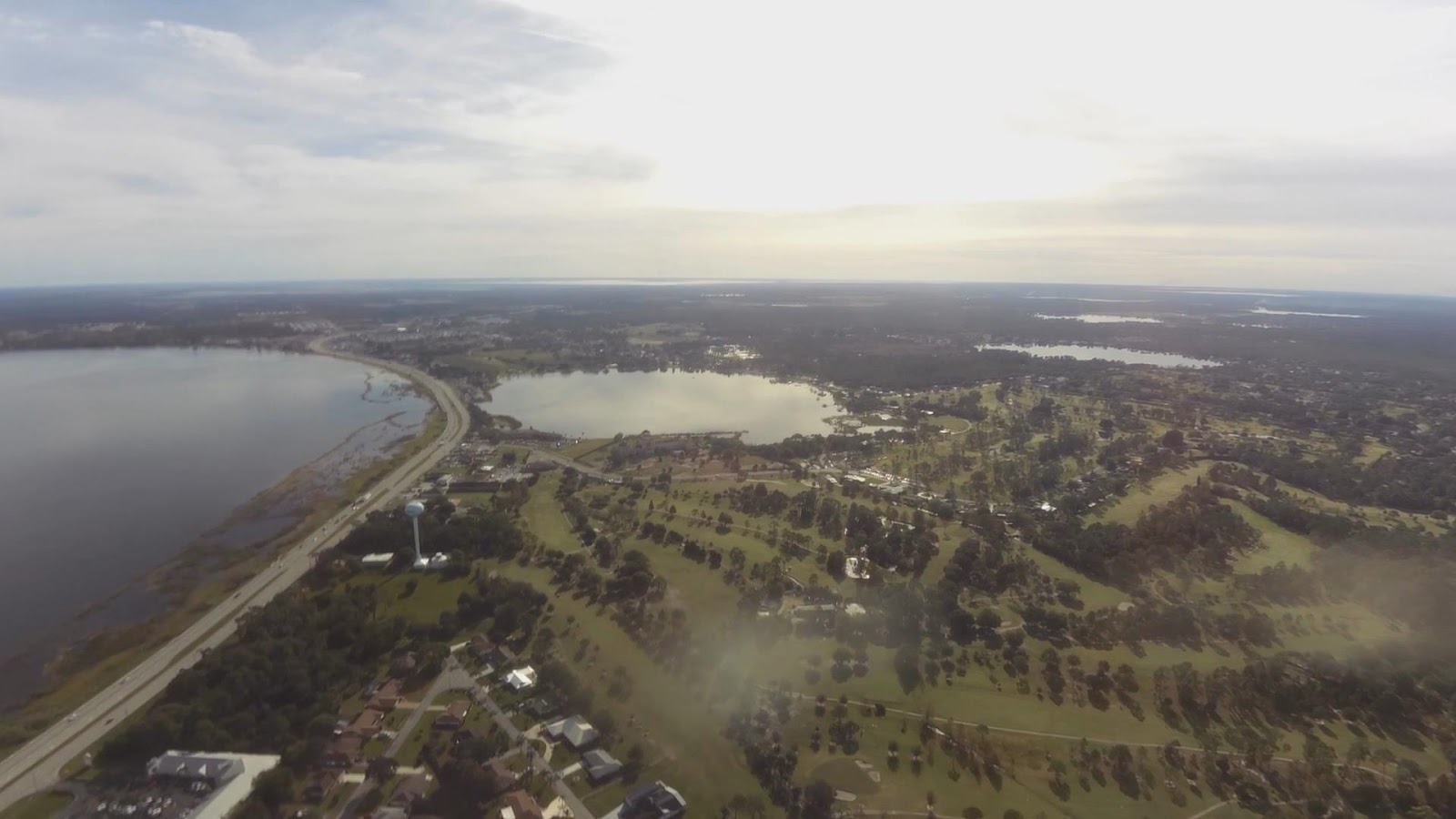
The trip home was uneventful except for the scenery.  Florida is beautiful. Lakes and waterways are everywhere, cities rise up to decorate the horizon and even at low altitudes you can see forever. I really like landing on RWY36. Right next to a canal, the downwind points right at metropolitan Tampa. This is a wonderful place to fly.

Video Notes: Zephyrhills


Thursday, December 17, 2015

I nailed the glassy

I left Sally at her comfortable covered tie down spot in Tampa and drove the 70 miles to Winterhaven, Florida. I arrived before sunset, checked into the hotel and then immediately drove the ten minutes over to the seaplane base. I wanted to be sure I knew the way to insure I wouldn't be late for my ground school class starting at 7:30 am the next morning. The sun was setting behind a Piper Cub on floats. This was paradise.

First let me stress that his is NOT a trivial undertaking. There are many new complex ideas to be understood, lots of new terminology, and a totally new airplane to be learned. I was back in the student role once again and climbing the learning curve at my age just isn't as easy as it once was. Fortunately, Jon Brown has put together an excellent organization and his instructors and staff are all top notch. It was a fantastic experience.

The iconic Piper Cub is just a joy to fly. My first challenge was to climb into the machine. Although I got better at it, there is just no graceful way to get into the back seat. Once the instructor climbs in the forward visibility is gone. The student is left with some triangular slices of windscreen on either side of the instructors head, the tachometer on the left and altimeter on the right. Quite a change from the plethora of colorful information provided from Sally's panel. But it is enough. Look outside. Pick reference points. Look at the relationship of the wing to the horizon. Vx, Vy, V anything is 60kts. VSI is your gut. Inclinometer is your butt. Glorious. I love this plane.

The airport is nearly any lake you can see, and there are thousands of lakes in Florida. The runway is now a "Lane" and it can be in any direction. You land into the wind. Simple, but not easy. Gone is your primary reference, the asphalt runway with centerline and numbers. How do you determine the wind? How do you fly a good downwind? How do you handle different surface conditions?

The most challenging landing for me was the "Glassy Surface". When the water is smooth you lose all depth perception. The closest analogy is landing at night without a landing light, but even this comparison fails because the runway lights are there for peripheral vision. This is truly flying on faith into a black hole. The technique used is to set a pitch and power configuration at an "LVR" (Last Visual Reference) and wait (patiently) for the airplane to land. My brief summary makes it sound simple, it isn't.

I still get "check-itis". Sitting down in the office with Jon and taking the oral exam is an experience in itself. Fair but firm, he probed each area to insure I had at least the minimum amount of knowledge. I was worried that too many times my response was "I don't know", but finally he said let's go fly.

He wasted no time. One maneuver to the next in rapid succession. Some went well, some others didn't. My crosswind landing was lousy. When we walked back in I didn't know and he gave no indication. "Let's debrief in my office." It was an acceptable flight. He said I was safe. "...and you nailed the glassy."

So now I am a Single Engine Seaplane pilot with a license to learn.

Jack Brown's Seaplane Base

Friday, December 4, 2015